Criminal Investigation Department

Criminal Investigation Department

The Criminal Investigation Department (CID), also referred to as the plain clothes branch, was the core of the force’s serious crime detection and prevention initiatives. Plain clothes work appears to have its origins within the Southern Rhodesia Constabulary, circa 1911 and there is evidence of a fingerprint bureau having been established as early as 1907. Immigration control had been implemented in 1903 and by 1913 the Officer Commanding the CID was the de facto Chief Immigration Officer. Since inception, the CID had its headquarters in Bulawayo. This was changed in February 1959, when the Headquarter element was moved to Salisbury to a set of offices within Morris Depot. The general structure of the CID was as indicated below:


  • Headquarters Section

    • Forensic Science Laboratory
    • Central Criminal Bureau (Fingerprint Bureau)
    • Criminal Records Office
    • Firearms Registry
    • Deportations Section
    • Scenes of Crime Examination Section (Photographic Sections at major CID Stations)
    • Questioned Document Examiner

  • Crimes of Violence (also known as Homicide Section in earlier times)
  • Law and Order Section (created in the early 1960’s)
  • Immigration Section (until 1954)
  • Property Section
  • Illicit Gold Dealing Section
  • Drug Section – illicit and illegal drugs control
  • Fraud Section – dealing in falsitas crimes
  • Photographic Studio (major centers for scenes of crime photography)

Provincial Stations and those in the smaller towns would deploy detectives to investigate crime across the spectrum of the above disciplines. Each province was commanded by a Provincial Criminal Investigation Officer (PCIO) responsible to the Officer Commanding CID.

Depot

Depot

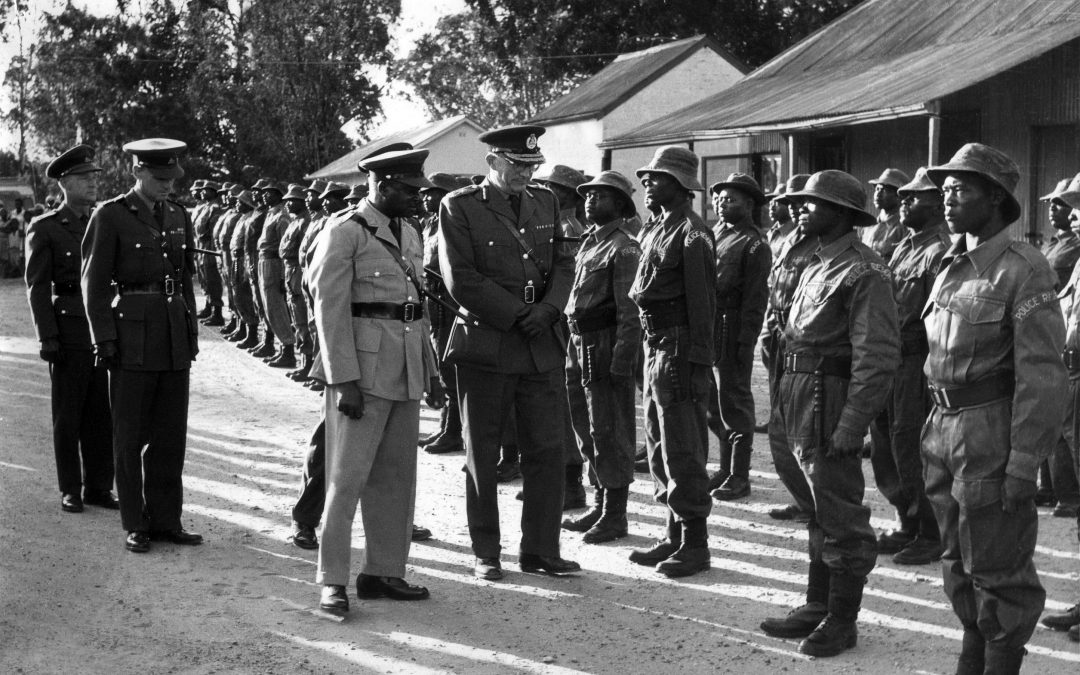
Training was a cornerstone of the BSA Police, and the dedicated Training Branch oversaw all instruction at the two principal depots, Morris and Tomlinson. Every recruit passed through one of these establishments on a structured six‑month course that combined discipline, law, fieldcraft, and practical policing skills; for those at Morris Depot, this foundation was followed by an additional phase at the Driving School, one at Cranborne Barracks and another in Bulawayo, ensuring that junior ranks entered service fully prepared for the operational demands of the force.

  • Tomlinson Depot
  • Police Band
  • Morris Depot
  • Armoury Section
  • Ballistics Section
  • Musketry Section
  • Provost Section
  • Police Dog Section (Training)

Special Branch

Special Branch

The Special Branch was responsible to the Deputy Commissioner (Crime and Security) for the gathering of intelligence. Certain sections within the BSA Police had been tasked with intelligence work since the late 1930’s, dealing mostly with aliens control and immigration. During the course of the Second World War a section calling itself XB had been formed.

The period of the Federation saw the British implement a Federal Intelligence and Security Bureau (FISB).  This was an MI5 initiative, but XB remained intact. The breakup of the Federation resulted in the introduction of an autonomous Branch of the Force, called Special Branch in July 1962. With the later formation of the Central Intelligence Organisation (CIO), the Special Branch became a Branch of that new intelligence organisation.  It became known as Branch 1. As noted above, the OC SB reported to two channels of command.

The Ground Coverage scheme of the BSA Police provided Special Branch with a uniquely granular, village‑level picture of political sentiment and population movement; it was essentially an early‑warning system built into everyday policing. Because constables were embedded in their communities, their routine observations fed a steady stream of low‑level intelligence that Special Branch could synthesise into broader assessments of subversion, agitation, and emerging threats.

Special Branch stations were established in most of the larger towns throughout the provinces. The functions of the Special Branch included the following:


  • European/Counter Intelligence Desk – monitoring the inflow of immigrants or visitors to Rhodesia, from hostile or Eastern Block nations, and concern with the influence of Communist philosophies spread by Europeans, in addition to observations of unfriendly nations representation in Rhodesia (through diplomatic and journalistic infiltration);
  • Nationalist Desk – black nationalist aspirations were the core of dissent around which the liberation struggle evolved and the close monitoring and thorough infiltration of nationalist political parties played a key role in the provision of intelligence, by Special Branch, to Government;
  • Projects Section – as with most intelligence organisations of the 1960’s and 70’s, special projects and initiatives were abundant in the face of political dissention and guerilla warfare. This section was the initiator of psuedo operations, later to become the well known, much feared, Selous Scouts, amongst other successes;
  • Technical – a specialist division within the intelligence community concerning itself with secret communications, mail and communications interception, and the gadgetry of modern day counter espionage and terrorism operations;
  • Terrorist Desk (initially part of the Nationalist Desk) – concerned itself with intelligence gathering and support of the defence forces in their operations against terrorist gangs which commenced infiltrations into Rhodesia during the early 1960s, in the absence of credible military intelligence initiatives;
  • Trade Union Desk – initially, the trade unions played a pivotal role in uplifting nationalist sentiment in Rhodesia, before the more well-recognised nationalist parties evolved. The unions' political sentiment was closely monitored.
Support Unit

Support Unit

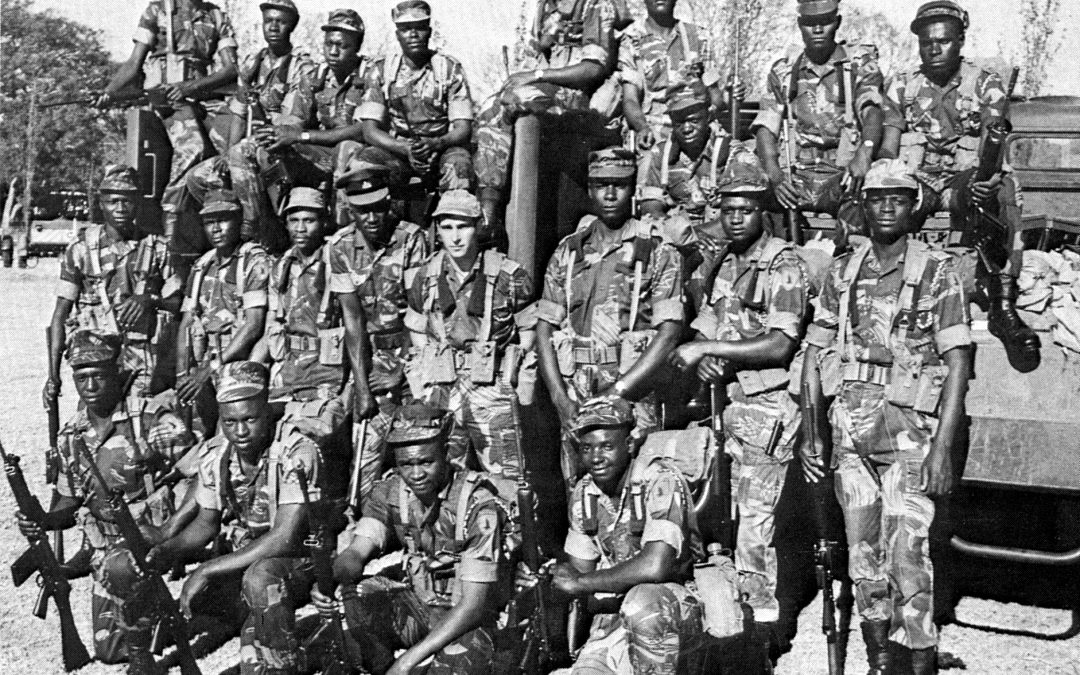
The Support Unit’s origins go back to the formation of an Askari Platoon after the First World War. Many of its men had seen action with the Rhodesia Native Regiment (RNR) in German East Africa and were of alien origins. Their function was mostly ceremonial. With the growth of nationalist unrest in the early 1960’s the size of the unit was expanded to three troops and their role became a little more diverse, including riot and crowd control. The counter-gueurilla campaign extended the unit into the new role of counter terrorist operations, during which the unit developed its reputation for toughness. The Support Unit was regarded as an autonomous Branch of the force and was based in Tomlinson Depot comprising a dozen ‘Troops’ of platoon strength. Troops were designated alphabetically A-L, including G Troop which was the Headquarters Troop used for ceremonial and Government House guard duties.

The inflow of National Service members was directed mostly towards the Support Unit. With the escalation of the war the Unit ended up with some 31 Troops, including G Troop, and had, due to its size, moved to new barracks at Chikurubi, on the edge of Salisbury. At Chikurubi the Support Unit barracks had its own armoury, quartermaster stores, transport section, training wing, provost, clinic and living quarters for both black and white members, thus becoming an almost autonomous element of the force. Towards the end of 1978 the Support Unit restructured its Troops into Company units ranging from A Coy. to L Coy., with a Headquarters Company, by the end of the war. The Headquarters company included a mounted infantry styled unit, which fell under Support Unit control in 1978, and the Ceremonial Troop. The unit was a proud, highly decorated, yet unsung part of the BSA police, and security forces generally.

Police Reserve

Police Reserve

A reserve force was first muted in 1913 and with the advent of World War I there is reference to “Supernumerary Constables” being used in the towns, considered to be a reserve.  The Police Reserve, as it came to be known, had been established when the Empire had been placed on a war footing during World War II and there is evidence of 536 reservist volunteers having been recruited as early as 1940.  A small number, later to become known as auxiliary reservists, were paid for their services.  Shortly after the surrender of axis forces, the reserve had been stood down from its wartime duties, and most members reverted to supplementing the civilian regular police.   There was a post war growth in the reserve and by 1952 there had been over 1,000 reservist volunteers on the books.   By the beginning of the Rhodesian Bush War, some 26 thousand reservists had volunteered for service with the BSA Police.

There had been established during the late 1950s a Special Constabulary with the eruption of nationalism.   Special volunteers, mostly elderly members, were limited to their local areas to supplement numbers during the political disturbances before the insurgency.  A Reconnaissance Unit was established and equipped with armoured cars, for use mainly in riot control, but was later stood down once the insurgency began.

The structure of the reserves changed little over the years

  • The ‘A’ Reserve – did a minimum of 4 hours of duty per week and as a consequence received a greater level of training and equipment. The A Reserve members dress in the same ranks and uniforms as the regular force, and included women officers. Their service was mostly at established police stations around the country.
  • The ‘B’ Reserve (better known as the Field Reserve) were basically reservists on call, for help during emergencies. As the insurgency developed, these calls became more regular. Many farmers, who were not subject to military call-ups, and many of their wives joined the ‘B’ Reserve. They had no set hours and consequently had less training and only a basic issue of equipment.  A Women Field Reserve had been established in 1960, initially with just 21 members, but this escalated with growth during the insurgency. There was also an African Police Reserve, initially established in the 1950s, which only really expanded successfully in 1960.  The Field Reserve made up a significant portion of the Police Anti-Terrorist Unit (PATU) during the war.

The police reserve established the Police Reserve Air Wing (PRAW) in 1957 and was made up of civilian pilots who used their own aircraft to support police operations. Principally the role of PRAW was that of surveillance and search in aid of the regular police.   The air wing took a more combative role during the insurgency along with logistics support into remote air fields.  The unit assisted elements of the  Rhodesian Air Force when call upon to do so.  There were other specialist units, such as the Marine Division, where reservists used their own boats to patrol the large areas covered by lakes and rivers.  Those reservists with specialist skills (one being indigenous language skills) served throughout the BSA Police in regular Branches, such as Special Branch or the Signals Unit.