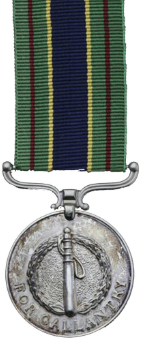
Medal Recipients
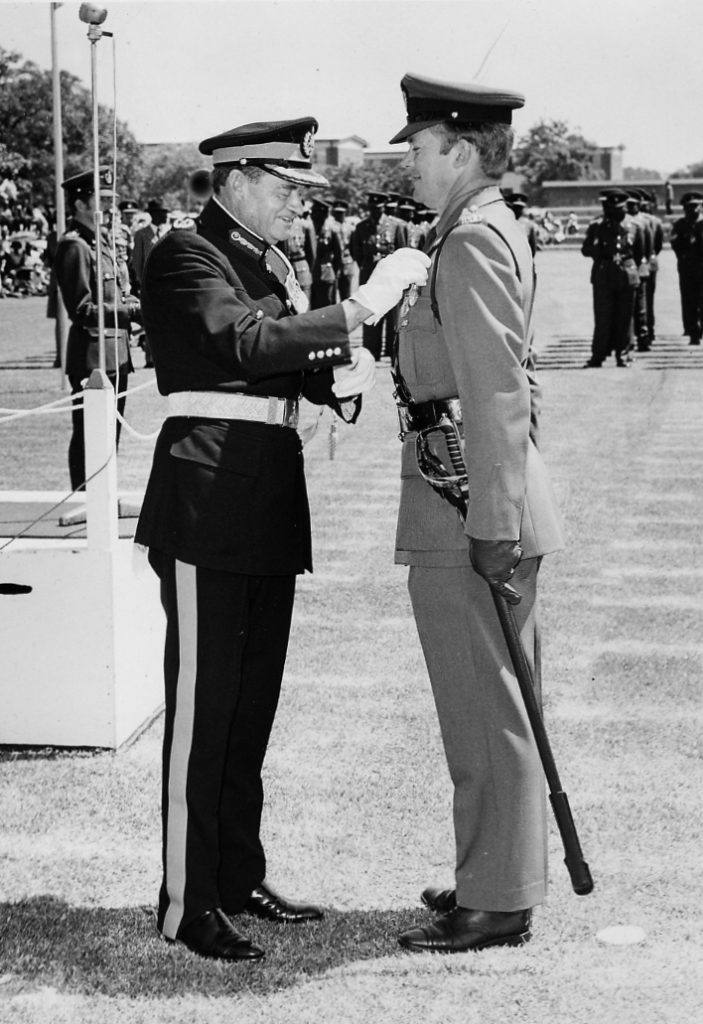
This page is dedicated to those members of the British South Africa Police who have been awarded medals or honours during their service in the force or subsequent to service in the force. The page has been split into two sections:
- British and Colonial Awards
- Rhodesian Awards
Information is generally ordered by surname and first names, followed by the life span of the person in brackets, or birth death years. Existing decorations at the time of the award are listed along with a force number and period of service in the BSA Police, in brackets, the rank at the time of the award, and the date of the award. If you believe you have found any errors in these listings, please report them to the web site administrator , and where possible provide credible supporting documentation.
It is perhaps pertinent to quote from the Outpost Editorial of August 1965,
“A POLICEMAN’S gallantry is a personal, and often a lonely, thing. He carries out his duties in an environment in which it is impossible for him to know from one moment to the next, by day or night, throughout his twenty years or more of service, when the test will come or around which corner the danger may lurk.
He is not a soldier, tensed to a pitch of warlike hate, as among his comrades he hurls himself over the top to kill or be killed by a loathsome enemy. For the policeman it is different; his courage must be cool, un.emotional, and born of an inner conviction that the sacrifice which may at any moment be required of him is one without which society would be unable to survive.
In return, society incurs a certain responsibility towards its policemen. On to their shoulders, during the past 120 years or so, it has managed to shuffle off the burden of protecting its members from every internal enemy, from the petty thief to the murderer and saboteur. This responsibility, society may now feel, it adequately discharges by remunerating the Constable at a rate higher than that of the road-sweeper but rather less than that of the factory hand.
The policeman’s loyalty to the traditions of his service cannot, of course, be bought-it is beyond price-but society owes more than it can pay in cash. One means it still has of repaying its debt to its policemen is to give them due honour when it may for their courage and devotion if they step beyond the strict line of duty in their work of protecting the community.”
Please note that these notable former members of the BSA Police should be listed on the genealogy website WikiTree which is accessible to non-subscribers. If you are descendant family of these notable members of the BSA Police, please consider joining Wikitree and commencing development of their family trees.
British and Colonial Awards
The Victoria Cross
The following persons, who were members of either the Mashonaland Mounted Police or Bulawayo Field Force (forerunners of the British South Africa Police), and later BSA Police, are recipients of the Victoria Cross, the highest and most prestigious award for gallantry in the face of the enemy that can be awarded to British and Commonwealth forces:
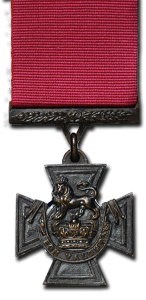
The Victoria Cross
Nesbitt, Randolph Cosby:
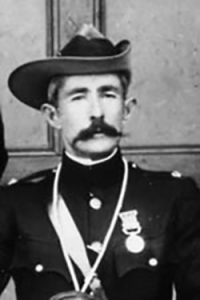
Inspector Randolph Nesbitt VC
On 19 June 1896 at Mazoe, near Salisbury, Rhodesia, Captain Nesbitt led a patrol consisting of only 13 men to go to the rescue of the miners at the Alice Mine in Mazoe Valley, who were surrounded by hordes of rebels. Captain Nesbitt and his patrol fought their way through the enemy and succeeded in getting the beleaguered party (including three women) back to Salisbury, in spite of heavy fighting in which three of the small rescue party were killed and five wounded.
At the time, Nesbitt was 28 years old, and a Captain in the Mashonaland Mounted Police, British South Africa (predecessor of Southern Rhodesia) Forces during the Mashona Rebellion, Rhodesia when the deed took place. He later became a Native Commissioner and served in the Goromonzi district for many years. His medal is held in the National Archives of Zimbabwe.
Booth, Frederick Charles (1630) (1890 – 1960)
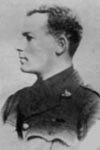
Booth, Frederick Charles VC
Booth was a 26 year old Sergeant in the British South Africa Police attached to the Rhodesian Native Regiment during the First World War, when on 12 February, 1917 (World War I) at Johannesbruck, in German East Africa (now Tanzania), during an attack in thick scrub on an enemy position, Sergeant Booth went forward alone to rescue an injured man. He then rallied the poorly organised native troops and brought them to the firing line.
On many previous occasions this NCO had set a splendid example of pluck, and endurance. He was born in Holloway, North London, and educated at Cheltenham College served in the British South Africa Police, in Southern Rhodesia, from 1912 to 1917. Booth died on September 14, 1960, in Brighton, United Kingdom and is buried at Bear Road Cemetery, Brighton, Sussex, England, in the Red Cross Plot. The present whereabouts of his Victoria Cross is unknown.
The following two recipients of the Victoria Cross are listed by association only. They were not members of the BSA Police, but the units they served were a form of voluntary reserve which came under the control of a common command during the rebellion.
Henderson, Herbert Stephen
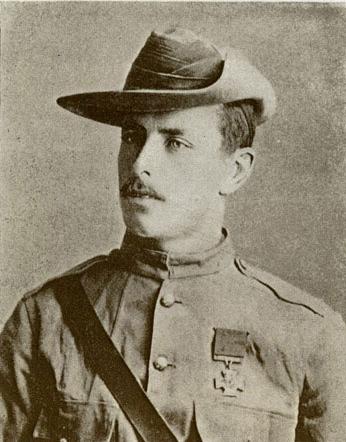
Henderson was a 26 years old Trooper in the Bulawayo Field Force, British South African Forces during the Matabeleland Rebellion, Rhodesia when on 30 March 1896 at Campbell’s Store, near Bulawayo, Rhodesia, a patrol which had been sent to the rescue of another beleaguered patrol, was surprised by rebels and Trooper Henderson and another trooper were cut off from the main party. The second trooper was shot through the knee and his horse killed, so Trooper Henderson put the wounded man on his own horse, and, walking beside it, made his way to Bulawayo, 35 miles away. They had to move principally by night, as the country was full of marauding rebels and they had no food for two days and one night. His medal is held in a museuam in the United Kingdom.
Baxter, Frank William (1869 – 1896)
Baxter was a 26 years old Trooper in the Bulawayo Field Force during the Matabeleland Rebellion, when on April 22, 1896 (Matabeleland Rebellion), near Umguza, Matabeleland, Rhodesia, he gave up his horse to a wounded comrade who was lagging behind, with an enemy force in hot pursuit. Baxter then tried to escape on foot, hanging on to the stirrup of another mounted scout of the Bulawayo Field Force, until he was hit in the side by enemy fire. He let go of the stirrup and died moments later. He was born on 29 December, 1869 in Woolwich, London. Baxter is buried at Bulawayo Town Cemetery, Bulawayo, Zimbabwe. His medal is in the Ashcroft collection.
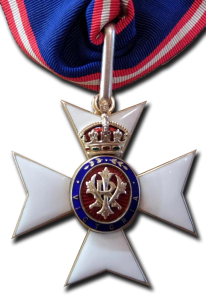
Knight Commander of the Royal Victorian Order (KCVO)
The Royal Victorian Order is a dynastic order of knighthood established in 1896 by Queen Victoria. It recognises distinguished personal service to the monarch of the Commonwealth realms, members of the monarch’s family, or to any viceroy or senior representative of the monarch.
There was only one BSA Police recipient of the KCVO:
- Pestell, Sir John Richard (1916-2005) – CPM (No. 3815 – served from Apr-1939 to Jun-1965) post BSAP Service on 9-Jul-1969. Sir John was Private Secretary and Comptroller to the Governor of Southern Rhodesia (1965-1969)
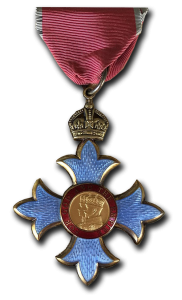
Knight Commander of the Most Excellent Order of the British Empire (KBE)
The Most Excellent Order of the British Empire is a British order of chivalry, rewarding contributions to the arts and sciences, work with charitable and welfare organisations, and public service outside the civil service.
There was only one BSA Police recipient of the KBE:
- Edwards, Sir Alfred Hamilton Mackenzie (1862-1944) – CB; MVO (served from Nov-1912 to Jan-1923) Major General – Commissioner of Police.
Commander of the Royal Victorian Order (CVO)
There were two BSA Police recipients of the CVO:
- Graham, Malcolm David (1865-1941)(BSA Company Police pre amalgamation – served from 1891 to Dec-1892) post BSA Police service 0n 1 January 1919;
- Ross, John Ellis (1893-1965) (Served from Oct-1913 to Dec-1950) Commissioner of Police on 1 January 1947;
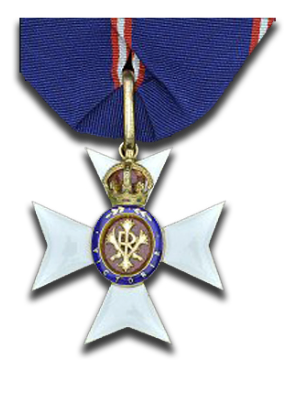
Commander of the Most Excellent Order of the British Empire (CBE)
The Most Excellent Order of the British Empire is a British order of chivalry, rewarding contributions to the arts and sciences, work with charitable and welfare organisations, and public service outside the civil service.
British South Africa Police Recipients of the Order were:
- Appleby, James (1899-1985) – KPM (No. 2123 – served from Oct-1919 to Jun-1954) Commissioner on 8-Jan-1954;
- Barfoot, Frank Eric (1913-1971) – QPM; CPM (No. 3342 – served from Apr-1933 to Jan-1968) Commissioner on 6/13-Jun-1964;
- Capell, Algernon Essex (1869-1952) – DSO (served from Jul-1913 to Feb-1926) Colonel on 3-Jun-1924;
- de Quehen, Basil Maurice (d.1993) – MVO (No. 3136 – served from Nov-1929 to Oct-1949) Post service with BSAP on 1-Jan-1959;
- Jackson, Harold (1903-1998) – KPM; CPM (No. 2853 – served from Feb-1927 to Mar-1958) Lieutenant-Colonel on 1-Jan-1958;
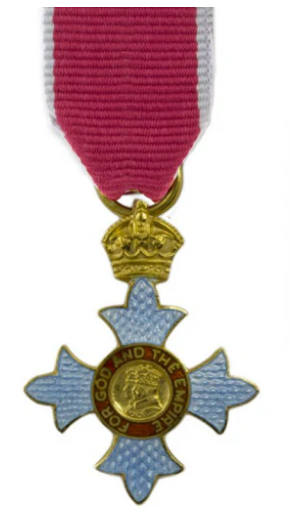
- Morris, John Sidney (1890-1961) (No. 1119 – served from Oct-1909 to Apr-1945) Commissioner on 3-Jun-1935;
- Parson, George (1879-1950) – DSO; MID (served from Aug-1906 to Feb-1929 in Southern Rhodesia Constabulary, a predecessor force of the BSAP) Post Service with the force on 4-Jun-1934;
- Ross, John Ellis (1893-1965) – CVO; KPM (No. 1771 – served from Oct-1913 to Dec-1950) Commissioner on 8-Jun-1950;
- Spurling, Basil Gordon (1908-1991) – QPM; CPM (No. 3100 – served from Apr-1929 to Apr-1963) Commissioner on 13-Jun-1959;
- St. Quinton, Noel (d.1970) (No. 941 – served from Jan-1908 to Mar-1909) Post Service;
- Stops, George (1876-1940)(served from Oct-1896 to Feb-1933) Commissioner on 3-Jan-1933; and
- Stubbs, William Frederick (d.1987) (No. 2434 – served from 14-Nov-1921 to 17-Apr-1924).
Officer of the Most Excellent Order of the British Empire (OBE)
The Officer of the Order of the British Empire is an order of chivalry created in 1917. This award is one of five classes (Member, Officer, Commander, Knight Commander, and Knight Grand Cross). It also had a medal known as the British Empire Medal which was mostly discontinued in 1993, but which several members of the BSA Police were awarded
The recipients of the order were:
.
- Adams, Arthur Vesey (d.1972) (No. 1672 – served from Apr-1913 to Apr-1933) Post BSAP Service on 2-Jan-1942;
- Black, JB – DFC (No. 3768V) Pre BSAP Reserve Service (Joined 1966);
- Brundell, Joseph Cyril (d.1938) (No. 1142 – served from Jun-1901 to Oct-1935) on 1-Jan-1935;
- Clemow, Hedley William (1890-1975) (No. 1701 – served from Aug-1913 to Oct-1945) Major on 18-Jun-1942;
- Duncombe, Charles William (b.1907) MBE; CPM (No. 3102 – served from Apr-1929 to Jan-1962) Post BSAP Service on 1-Jan-1964;
- Fitzwilliam, George Lionel Canard (b.1908) (No. 3089 – served from Mar-1929 to Nov-1963) S/A/Commissioner on 1-Jan-1964;
- Fleming, Malcolm Granger – Police Reserve – Lieutenant Colonel on 1-Jan-1954;
- Hamilton, Richard (d.1962) (No. 671 – served from Jun-1905 to Feb-1939) Major on 11-May-1937;
- Harries, George Mervyn (1912-2001) – QPM; CPM (No. 3369 – served from Feb-1934 to Oct-1967) Deputy Commissioner on 1-Jan-1965;
- Harrison, Frederick William (1896-1963) – CPM (No. 2323 – served from Jul-1920 to Jan-1951) Lieutenant Colonel on 9-Jun-1950;
- Hickman, Arthur Selwyn (1900-1976) (No. 2622 – served from Aug-1924 to Nov-1955) Chief Superintendent on 9-Jun-1944;
- Phillips, William James (d.1957) (No. 221 – served from Aug-1901 to Oct-1931) Major on 30-May-1919;
- Shillingford, Norman Frederick (No. R524) Superintendent (Reserve) on 7-Jan-1949;
- Stephens, Francis Trant (d.1946) – MC (No. 560 – served from Oct-1903 to Jul-1920) Major on 30-May-1919;
- Syratt, William James (No. 4129 – served from Jun-1946 to Oct-1949); and
- Thornton, George James (d.1948) (No. 18 – served from Nov-1896 to Apr-1923) Major on 1-Jan-1919
British Empire Medal (Gallantry)
The British Empire Medal is granted in recognition of meritorious civil or military service. From 14 January 1958, awards of the BEM made for acts of gallantry were formally designated the British Empire Medal for Gallantry and consisted of the BEM with a silver oak leaf emblem worn on the ribbon. The honour is divided into civil and military medals in a similar way to the Order of the British Empire (OBE) itself. Members of the British South Africa Police were awarded the civilian medal.
- Thatcher, John Haigh Howe (No. 6126/9105) Constable on 26-Apr-1963 – Constable Thatcher had been part of the same team as Constable Ngwenya saving the lives of children in the Shashe River. He too acted with courage and displays of personal bravery, in mounting the rescue bid. John joined the BSA Police in February 1960 and did two tours of duty, retiring eventually in April 1978. He passed away in March 2013 in Johannesburg, South Africa;
- Ward, Harold Keith (No. 7808L) Field Reservist on 1-Jun-1963 – Field Reservist Ward had been part of the same team as Constable Ngwenya saving the lives of children in the Shashe River. He too acted with courage and displays of personal bravery, in mounting the rescue bid;
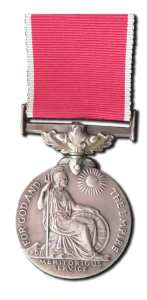
- Ngwenya, Jaconiah (No. 16263) Constable on 26-Apr-1963 – Constable Ngwenya had been part of a team which had saved the lives of two teenage African Children who were floundering in the flooded and swollen Shashe River near the Makaholi Research Station, in the Victoria Province. The three policemen, who acted with courage and displays of personal bravery, mounted a daring and dramatic rescue bid – Supplement 42974 to the London Gazetter describes the incident as such:Two African children were trapped on an island by rising flood waters of the crocodile infested Shashe River. The children had taken refuge in a tree sixty yards from the river bank; the island was completely submerged and the river in full spate. Thatcher and Jaconiah attempted to rescue the children but were unsuccessful. They then went in search of help and returned at about 6 p.m. with three Europeans including Police Reservist Ward. Thatcher volunteered to swim across to the children and after a length of .electric cable had been tied around his waist, tie entered the flood waters. When only a short distance from the submerged island, the length of cable ran out and he had to be pulled back to the shore. The cable was then extended by tying a length of garden hosepipe to the end and Constable Thatcher once again entered the water. By this time it was dark. He succeeded in reaching the children and seizing one of them and holding him with both arms, he was dragged back to safety. Thatcher and the child were submerged for most of the return journey and oh reaching the bank Thatcher was completely exhausted. Jaconiah then volunteered to bring the remaining child back. The cable was secured around his waist and he set off into the river. On nearing the tree where the child was taking refuge, the current proved too strong and he was swept down the stream. He had to be hauled back to safety. Ward then volunteered to attempt the rescue. The cable was fastened to him and he swam out into the river. This attempt was successful and Ward although submerged for most of the journey returned holding the child with both arms. Ward was also completely exhausted after the rescue. The three officers displayed great courage and disregard for their personal safety in effecting the rescue.
Colonial Police Medal
The Colonial Police Medal was awarded for 18 years full-time, continuous and efficient service in the Police Force of any British Colony or Overseas Territory. Members of the British South Africa Police were also recipients of the civilian medal. The medal was issued mostly for meritorious service, but also has been issued for police gallantry. There were three awards of the gallantry medal to members of the BSA Police. Constables Tachiwona and Garikayi were awarded the gallantry medal on 9 February 1964 for their courageous action in apprehending armed criminals near Salisbury, Southern Rhodesia. Sergeant Alexander ‘Sandy’ Coutts received his award in November 1964, for his gallant actions in the face of a serial killer, Leopold Smith, who was later to be executed.
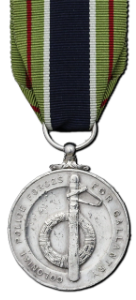
Gallantry
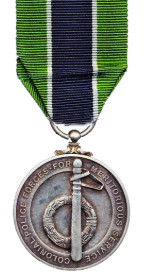
Meritorius
Colonial Police Medal For Gallantry
- Coutts, Alexander Cameron Sibbald ‘Sandy’ (No.5234) Sergeant on 12-Nov-1964;
- Garikayi (No.12064) Constable on 9-Feb-1964;
- Tichiwona (No. 17440) Constable on 9-Feb-1964;
Colonial Police Medal for Meritorious Service
Rhodesian Awards
The Conspicuous Gallantry Decoration
Gallantry and brave conduct of an outstanding order in a non-combatant capacity. There were only two gazetted awards of the Conspicuous Gallantry Decoration, both to civilians during the Rhodesian bush war. No members of the Defence Forces or Police were recipients of this medal.
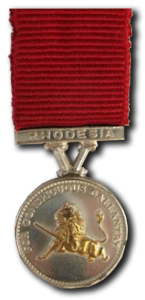
The Grand Officer of the Legion of Merit (GLM)
The Legion of Merit was a Rhodesian order of merit awarded to both civilian and military recipients for service to Rhodesia. Two members of the British South Africa Police were recipients of this medal:
- Flower, Kenneth (1914-1987) – ID; MBE; QPM; CPM (No. 3654 – served from Apr-1937 to Jun-1969) Deputy Commissioner on 27-Apr-1979; and
- Sherren, Peter Denis Wray Richard (1919-1995) – CLM; PCD; OLM; CPM; PLSM (No. 3862 – served from Aug-1939 to Feb-1978) Commissioner on 17-Jul-1978;
The Independence Decoration (ID)
The Independence Decoration (ID) was a Rhodesian civil decoration awarded to persons who played a notable and significant part in the Unilateral Declaration of Independence in 1965. The award was instituted in 1970, the first awards being made the same year. Twenty nine awards of the Independence Decoration were made between 1970 and 1979, 28 being made in November 1970 to Rhodesian Front politicians. No further medals were given out until April 1979, when an award was made to Ken Flower, by then the Head of the Rhodesian Central Intelligence Organization.
There were only two (former) BSA Police recipients of the Independence Decoration and they were:
- Barfoot, Frank Eric (1913-1971) – CBE; QPM; CBE (3342 – served April 1933 to January 1968) Commissioner on 11-Nov-1970; and
- Flower, Ken (1914-1987) – MBE; QPM; CPM (3654 – served April 1937 to Jun 1969) Deputy Commissioner on 20-Apr-1979.
(Note: both these awards were post BSA Police service of the individuals, but their roles were as serving officer at the time of UDI)
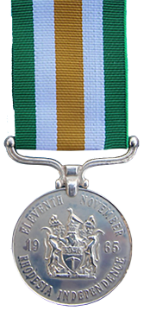
The Commander of the Legion of Merit (CLM)
The Commander of the Legion of Merit (CLM) was a Rhodesian civil decoration awarded to persons who gave distinguished service to Rhodesia.
- Allum, Peter Kevin (1926-2015) – OLM; PCD; CPM; PLSM (No. 3939 – Commissioner) on 11-Nov-1978
- Bristow, Sidney Frederick Samuel (1919-2008) – PCD; CPM; PLSM (No. 3844 – Commissioner) on 11-Nov-1972
- Sherren, Peter Denis Wray Richard (1919-1995) – PCD; OLM; CPM: PLSM (No. 3862 – Commissioner) on 11-Nov-1975
The Police Cross for Conspicuous Gallantry
The Police Cross for Conspicuous Gallantry (PCG) was a Rhodesian gallantry award for police officer recipients. The award was instituted in 1970, the first award being made in June 1975. The last award was made in September 1978. The award was the police equivalent of the Silver Cross of Rhodesia and, because of the BSAP’s seniority, ranked ahead it in the official order of precedence.
Five officers of the British South Africa Police were awarded the honour:
- Kampaundi, Columbus (21149) Constable on 20-Jun-1975 – Constable Kamupaundi of D Troop, Support Unit, had been travelling in a Rhino vehicle in convoy with other vehicles, when his vehicle came under fire. The vehicle was hit by an RPG-7 rocket, badly injuring others, including civilians, in the vehicle. After fending off two sustain attacks by the enemy, who eventually withdraw, Columbus, with total disregard for his personal safety, and now injured with lacerations and bruising from the rocket attack, ran several kilometres through the bush to get to nearby Rusambo to seek assistance. The Constable showed considerable bravery in his actions and conspicuous gallantry.
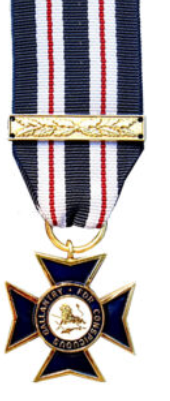
- Edwards, Derrick George (8158) Patrol Officer on 25-Mar-1977 – Patrol Officer Edwards was a Stick Leader in a PATU patrol which came under intense and sustained enemy fire resulting in a member of the stick being wounded in an open vlei area without cover. Derrick, with total disregard for his own safety and under heavy fire, crawled forward to assist his wounded comrade pulling him back to a place where he could be treated under cover. He also recovered a radio set, which had fallen on open ground during the initial contact, also while under fire from the enemy. During this encounter Edwards sustain two bullet wounds. While in great pain he calmly called for assistance on the recovered radio. After enemy fire broke off Derrick refused the available morphine, insisting that this be administered to his wounded colleague before they was evacuated from the contact area. Derrick Edwards demonstrated great gallantry and personal valour;
- Manyawu, Sylvester M (22150) Constable on 25-Mar-1977 – Constable Sylvester Manyawu was with Patrol Officer Gary Whitehead-Wilson, was on a vehicle patrol in the Operation Thrasher (Eastern Districts) area. Their vehicle was ambushed and subjected to heavy fire at a range of less than ten metres. Both men were wounded, the patrol officer in the face, shoulder and back; his companion five times in both thighs, lower right leg, right wrist and neck. Sylvester returned fire with his sub-machine gun, lost consciousness for a short period and then, partly recovering, tried to summon assistance on the radio. That, of course, was out of action, so he struggled out of the cab and continued firing at the attackers until his gun jammed. Undeterred, he then used Wilson’s FN and managed to drive off the terrorists. Wilson, who had been completely out of the action because of his wounds, was given first aid and the two then tottered to a nearby township where Sylvester left the patrol officer in comparative safety and went off to get help. He staggered for over three kilometers to a school and there collapsed. After a short period, he revived sufficiently to provide details for his and Whitehead-Wilson’s rescue. Both were evacuated and made good recoveries;
- Mazarire, Edwin (22327) Constable on 5-Aug-1977 – Constable Edwin Mazarire’ troop was ambushed one early morning in February as their vehicles were being driven up a short hill. The ambush was well mounted and well concealed and Hewitt, in the lead vehicle, suffered a serious abdominal wound in the first moments of the attack. Nevertheless, he returned fire from the cab with his shotgun. Meanwhile, in the back of the vehicle, Constable Moyo received injuries that later proved fatal, while Constable Mazarire received shrapnel wounds to a leg. Armed with a machine gun, Mazarire immediately and calmly returned fire, enabling the other passengers to climb out and take up defensive positions. As he paused to reload, he was again hit, this time by a bullet passing through his right arm above the elbow. Undeterred, Edwin completed reloading and resumed firing and then realized that the enemy fire was being concentrated at the cab in which Hewitt was trapped. Edwin then jumped to the ground, deliberately exposing himself to fire from close range and managed to get Hewitt out from the cab, round the exposed front of the vehicle and into a relatively safer position, protected by the front wheel and on the sheltered side of the truck. At this stage, he was further wounded in the left arm, thigh and back. Hewitt, though seriously injured and in considerable pain, now rallied and encouraged his men and, after about ten minutes, they managed to drive off the attackers. Hewitt then organized a follow-up operation by the half of his troop who were uninjured, took over radio communications and assisted his second in command, Lance Section Officer Billy Houghton, in guiding aircraft to the scene. Tim Hewitt died from his injuries about a week later; Edwin Mazarire partially recovered and returned to serve in the unit.;
- O’Brien, Lindsay Robert (9440) Lance Section Officer on 8-Sep-1978 – Lance Section Officer O’Brien was a member of the Support Unit and had been involved in many contacts and engagements with terrorists, in two of which he was injured by enemy fire, yet continued to command his section and engage his foe. In one incident Lindsay (known as ‘Kiwi’) had route marched his troop 17 kilometres and engaged insurgents who had another section of the Unit pinned down under fire. During a protracted follow up he received a serious shoulder injury, but continued on spoor until tracks were lost, before submitting to CASEVAC. In a later engagement O’Brien came under fire after laying ambush in an exposed position and was again severely wounded. An African colleague was killed in the action. Despite being in great pain and suffering, he continued to direct his troops under fire, eventually loosing consciousness. After recovery and basic field treatment he took back control of his troop and helped sweep the affected area. ‘Kiwi’ had demonstrated devotion to duty with great courage and personal valour without regard to his personal safety and suffering.
The Police Decoration for Gallantry
The Police Decoration for Gallantry (PDG) was a Rhodesian gallantry award for BSA Police officer recipients. The award was instituted in 1970, with the first award being made in June 1970. The last award of this medal was made in September 1979. The award was the police equivalent of the Bronze Cross of Rhodesia and, because of the BSAP’s seniority, ranked ahead it in the official order of precedence.
Twenty two officers of the British South Africa Police and Reserve were awarded the honour:
- Barker, James Melville ‘Jim’ (1932-) (No. 10328A – Field Reservist) on 23-Oct-1970
- Berry, Patrick Harry George (-2013) (No. 9268 – Patrol Officer) on 06-Dec-1979
- Bredenkamp, Walter Lawrence (No. 90314 – Field Reservist) on 25-Mar-1977
- Conn, Peter Alexander ‘Billy’ (1929-) (No. 17575C – Field Reservist) on 02-Aug-1974
- de Robillard, MCA (No. 24465 – Field Reservist) on 25-Mar-1977
- Hewitt, Timothy Charles (1952-1977) (No. 8525 – Posthumous (KIA 23-Feb-1977)) on 05-Aug-1977
- Katsiru, AE (No. 20792 – D/Constable) on 21-Feb-1975
- Kauzanani, E (No. – African Field Reservist) on 09-Jun-1978
- Lailey, Graham John (1951-) (No. 8329 – D/Section Officer) on 17-Aug-1979
- Ludeke, Barend Jacobus (1957-) (No. 10041 – Patrol Officer) on 05-Oct-1979
- Marshall, Benjamin Edwin Noel (No. 6188 – Section Officer) on 23-Oct-1970
- Masakwa, M (No. 16518 – Sergeant Major) on 08-Sep-1978
- Mathews, Thomas Bruce (No. 9010 – Section Officer) on 25-Mar-1977
- Mkandhla, D (No. – African Field Reservist) on 09-Jun-1978
- Ncube, M (No. 21609 – Constable) on 15-Oct-1976
- Norton, Keith Hall (No. 9172 – Section Officer) on 06-Dec-1979
- Paul, Duncan Jones (1955-) (No. 8980 – Patrol Officer) on 25-Mar-1977
- Phillips, Frederick Jan Smuts (-2002) (No. 5096 – Inspector) on 23-Oct-1970
- Shoko, C (No. 20174 – Constable) on 20-Jun-1975
- Soka, Godfrey (1958-1977) (No. 24825 – Posthumous (KIA 1-Sep-1977)) on 09-Jun-1978
- Sutherns, Geoffrey David (No. 10383 – Patrol Officer) on 05-Oct-1979
- Tiffin, Barry James (-1996) (No. 6075 – Section Officer) on 23-Oct-1970
- Twine, Julian Edward MBE (1942-2001) (No. 6511 – Inspector) on 21-Feb-1975