
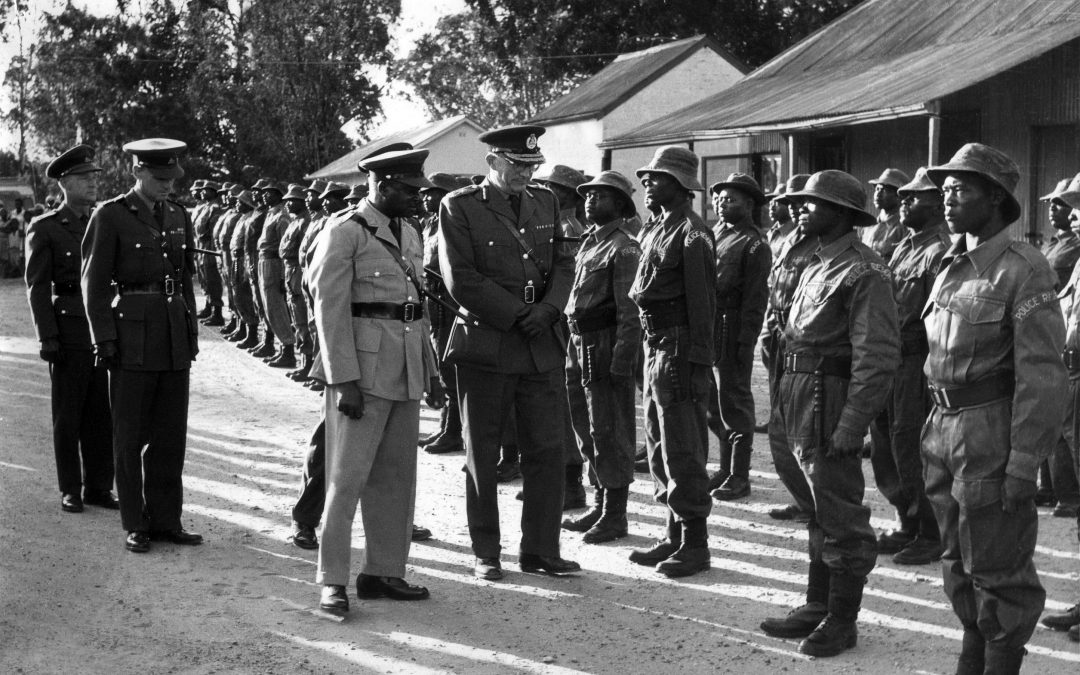
A reserve force was first muted in 1913 and with the advent of World War I there is reference to “Supernumerary Constables” being used in the towns, considered to be a reserve. The Police Reserve, as it came to be known, had been established when the Empire had been placed on a war footing during World War II and there is evidence of 536 reservist volunteers having been recruited as early as 1940. A small number, later to become known as auxiliary reservists, were paid for their services. Shortly after the surrender of axis forces, the reserve had been stood down from its wartime duties, and most members reverted to supplementing the civilian regular police. There was a post war growth in the reserve and by 1952 there had been over 1,000 reservist volunteers on the books. By the beginning of the Rhodesian Bush War, some 26 thousand reservists had volunteered for service with the BSA Police.
There had been established during the late 1950s a Special Constabulary with the eruption of nationalism. Special volunteers, mostly elderly members, were limited to their local areas to supplement numbers during the political disturbances before the insurgency. A Reconnaissance Unit was established and equipped with armoured cars, for use mainly in riot control, but was later stood down once the insurgency began.
The structure of the reserves changed little over the years
- The ‘A’ Reserve – did a minimum of 4 hours of duty per week and as a consequence received a greater level of training and equipment. The A Reserve members dress in the same ranks and uniforms as the regular force, and included women officers. Their service was mostly at established police stations around the country.
- The ‘B’ Reserve (better known as the Field Reserve) were basically reservists on call, for help during emergencies. As the insurgency developed, these calls became more regular. Many farmers, who were not subject to military call-ups, and many of their wives joined the ‘B’ Reserve. They had no set hours and consequently had less training and only a basic issue of equipment. A Women Field Reserve had been established in 1960, initially with just 21 members, but this escalated with growth during the insurgency. There was also an African Police Reserve, initially established in the 1950s, which only really expanded successfully in 1960. The Field Reserve made up a significant portion of the Police Anti-Terrorist Unit (PATU) during the war.
The police reserve established the Police Reserve Air Wing (PRAW) in 1957 and was made up of civilian pilots who used their own aircraft to support police operations. Principally the role of PRAW was that of surveillance and search in aid of the regular police. The air wing took a more combative role during the insurgency along with logistics support into remote air fields. The unit assisted elements of the Rhodesian Air Force when call upon to do so. There were other specialist units, such as the Marine Division, where reservists used their own boats to patrol the large areas covered by lakes and rivers. Those reservists with specialist skills (one being indigenous language skills) served throughout the BSA Police in regular Branches, such as Special Branch or the Signals Unit.