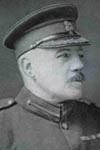
Blatherwick, James Kincaid ‘Jimmy’ (1869-1918)

Blatherwick, James Kincaid ‘Jimmy’ (1869-1918)

Regimental Sergeant Major – 1897 to June 1917

James “Jimmy” Blatherwick (Force No. 20) was born on 2 January 1869 in Cape Town, South Africa. He began his uniformed career in 1890 with the Bechuanaland Border Police, one of the frontier forces tasked with maintaining order across Britain’s expanding southern African territories. In 1896 he transferred to the British South Africa Police and, the following year, was appointed Regimental Sergeant Major—a role he would hold with distinction for nearly two decades.
Blatherwick first entered Rhodesia with the Matabeleland Relief Force during the Second Matabele War, serving in the campaign to suppress the uprising. His long service placed him at the centre of several formative conflicts, including both the Matabele rebellions and the Second Boer War, where the BSAP provided mounted infantry and border security. In 1911 he was selected for the BSAP contingent sent to London to represent the force at the Coronation of King George V, a mark of his standing within the regiment.
Promoted to Inspector in 1913, he later received a wartime military commission in February 1917, rising from Lieutenant to Captain and taking command of the Depot. Blatherwick died in Salisbury on 26 November 1918 during the influenza pandemic, shortly after the death of his wife. A memorial to him was erected at Morris Depot in 1921.

The Blatherwick Memorial: Morris Depot

A familiar and quietly imposing sight to generations of Morris Depot recruits from 1921 onwards was the Blatherwick Memorial, positioned on the northern edge of the Green Square where daily parades, inspections, and passing‑out ceremonies took place. The memorial was erected in honour of Regimental Sergeant Major George Blatherwick, one of the most respected early figures of the BSA Police, whose long service and uncompromising standards left a deep imprint on the character of the Force. His death in 1920 was felt keenly across the organisation, prompting senior officers and former colleagues to commission a permanent tribute at the Depot he had helped shape.
At the unveiling ceremony, Major General Sir Alfred H. M. Edwards, KBE, CB, MVO, the Commandant‑General of the BSA Police, paid a moving tribute to Blatherwick’s life and service. “Rhodesia has lost a true soldier, a fine character, and the Government a loyal servant… His loss to the Corps, which he loved, and for which he had done so much, is irreparable; the memory of him will, however, remain, and his example might well be accepted as the ideal to which all ranks should strive to attain.” Edwards went on to emphasise that Blatherwick had embodied the newly adopted regimental motto, Pro rege, pro lege, pro patria, the words now inscribed at the foot of the memorial tablet and long regarded as a reminder of the standards expected of every recruit who passed through the Depot.

Return to Regimental Sergeant Majors

Graham, Malcolm David

Graham, Malcolm David

Lt. Colonel

1 March 1890 to 1892
CB; CMG; CVO (1855-1941)

Malcolm David Graham CB; CMG; CVO (1865–1941) was born on 14 July 1865 in Grahamstown, Cape Province, and educated at Haileybury College before proceeding to Sandhurst. Commissioned into the British Army in 1885, he joined the Northamptonshire Regiment and soon found himself drawn into the expanding world of southern African frontier administration. His association with the British South Africa Company Police, though brief, was formative. He first appears during the tensions with the Portuguese at Mutasa’s kraal, and was subsequently appointed Adjutant of the Company Police in Fort Salisbury. When the original quasi‑military police force was disbanded in December 1891, Graham assumed command of the newly constituted and much reduced civilian body as Inspector‑General of Police, effectively becoming one of the earliest professional heads of policing in the territory.
Returning to imperial service, Graham continued a distinguished military and administrative career. He later served with the Royal Berkshire Regiment, rose to senior staff appointments, and became Secretary at the War Office. During the First World War he saw active service and was appointed Aide‑de‑Camp to the King, reflecting his standing within the upper tiers of the British military establishment. His honours included the CB (1915), CMG (1918), and CVO (1919). He died in Durban on 16 November 1941.

Return to Commissioners

Bodle, William ‘Billy’ (1855-1924)

Bodle, William ‘Billy’ (1855-1924)

Regimental Sergeant-Major

(BSA Company Police); Served October 1889 to 31 August 1891

William Bodle was born on 5 July 1855 in Alfriston, Sussex. He began his military career with the Sherwood Foresters (Nottingham and Derbyshire Regiment) before transferring first to the 17th Lancers and later to the 6th Inniskilling Dragoons; a move that brought him to South Africa. He saw active service in the Basuto War of 1880–81 with the Cape Mounted Rifles, gaining the experience that would shape his later career in colonial policing.
In 1884, Bodle was appointed Regimental Sergeant Major of the Bechuanaland Border Police. Five years later, in October 1889, Cecil Rhodes engaged him to help raise and organise the force that would accompany the Pioneer Column into Mashonaland. He accordingly joined the newly formed British South Africa Company Police as its Regimental Sergeant Major. After being released during an early austerity drive, he entered commerce in Fort Salisbury. However, he soon returned to uniform with the Salisbury Horse and took part in the occupation of Matabeleland. He subsequently became commander of the newly created Matabeleland Mounted Police with the rank of Major.
Bodle later served in the Rhodesia Mounted Police during the Jameson Raid, was captured by Boer forces, and deported to England. Undeterred, he returned to Rhodesia and re‑attested into the British South Africa Police, Matabeleland Division, as second‑in‑command with the rank of Lieutenant‑Colonel, eventually succeeding Nicholson. He retired from the BSA Police in April 1909 and returned to England.
During World War I he commanded the Norfolk and Suffolk Territorial battalions and later the Labour Battalion, receiving the honorary rank of Brigadier‑General in August 1917. Bodle, who had been awarded the CMG in 1901, died in his native Alfriston on 9 July 1924.

Allum, Peter Kevin

Allum, Peter Kevin

Commissioner

7 February 1978 to 1 August 1980 (Cessation of the British South Africa Police)
(1920-1995) CLM; OLM; PCD; PCM; PLSM

Peter Kenneth Allum, born on 12 June 1926 in Isleworth, United Kingdom, was educated at Gunnersbury Catholic Grammar School before beginning his early service in the Fleet Air Arm, an experience that shaped the discipline and technical competence he later brought to policing. He attested into the British South Africa Police as a trooper on 28 April 1946 and soon gravitated toward detective work, spending almost his entire career within the Criminal Investigation Department. His postings took him across the country, including Beitbridge (Immigration), Umtali, Salisbury, Bulawayo and Gwelo, where he developed a reputation for methodical investigative skill and steady leadership. Commissioned in 1960, Allum rose steadily through the CID hierarchy, becoming Provincial Commander (PCIO) for the Midlands Province in 1963 and later for Salisbury and Mashonaland in 1967. On 1 October 1970 he was appointed Officer Commanding CID, placing him at the centre of major criminal and security investigations during a turbulent period. His promotion to Deputy Commissioner (Crime and Security) on 7 February 1974 reflected both his seniority and his strategic importance within the organisation. Decorated with the PCD (1973), OLM (1976), CLM (1978), CPM and PLSM, Peter Allum retired to South Africa, where he died in Carltonville on 17 April 2015.

Deputy Commissioners
  • !
    Crime and Security – Denley, Jack (4261) (1923-1985) OLM; PCD; CPM; PLSM; RGSM – 7 February 1978 to 1 August 1980 (Cessation of the British South Africa Police). He continued as Deputy Commissioner of the Zimbabwe Republic Police until 6 February 1982 succeeding Allum as Commissioner.
  • !
    Administration – Atkinson, George (4094) (1923-1990) OLM; PCD; CPM; PLSM; RGSM 22 August 1977 to 22 September 1981
  • !
    Administration – Stuart, George Charles (4736) (b.1929) PMM, PLSM (and Bar), RGSM 22 September 1981 to 13 September 1983
  • !
    Personnel and Recruitment – Murray, Philip Stuart (4437) (1928-1995) PCD; PMM; PLSM; MLM; RGSM – ? to 1 May 1982 23

Return to Commissioners

Pennefather, Edward Graham (1850–1928)

Pennefather, Edward Graham (1850–1928)

Lt. Colonel – 1 March 1890 to 1892

Edward Graham Pennefather, born on 21 February 1850, pursued a long and varied military and policing career that spanned several continents and major imperial campaigns. He joined the British Army as a young man and was commissioned in April 1873 while serving with the 6th (Inniskilling) Dragoons, a regiment with a distinguished cavalry tradition. Pennefather saw active service in both the Zulu Campaign and the First Boer War, experiences that shaped his reputation as a capable field officer and contributed to his promotion to Lieutenant Colonel in October 1888. In November 1889 he was appointed commander of the British South Africa Company Police, a role that placed him at the centre of early colonial expansion in Southern Africa. He participated in the occupation of Mashonaland and was directly involved in the skirmishes at Massi Kessi, events that underscored the volatile nature of the region during this period. When the “military police” accompanying the Pioneer Column were disbanded, Pennefather was relieved of his command and subsequently returned to regular army service. He retired from the Army in May 1895 and soon after accepted the post of Inspector General of Police in the Straits Settlements, extending his influence into Southeast Asia. Edward Pennefather died in Natal on 29 April 1928, closing a career marked by mobility, conflict, and administrative responsibility across the British Empire.