
Motor Cycles
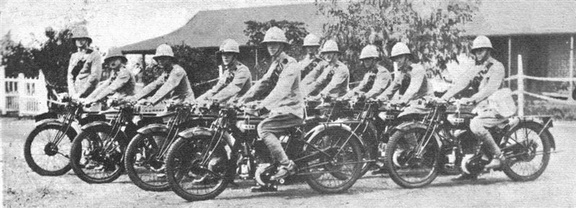
“Horse transport is a thing of the past, and the B.S.A. Police, mounted on motorcycles, would result in higher efficiency at a lower cost of upkeep in every branch of work at present undertaken by the horse.” – From a letter to The Outpost September 1926. Less than a year later this photograph appeared. All the riders are wearing spurs as it would seem that that mounted dress order was applicable for motor cycles.
FROM 1930 TO 1965
From the 1930s until UDI the Force used British motorcycles, which were either Matchless or B.S.A. models in the 500cc to 650cc model range. During the post-war years some 500cc Indian 741 models were used by the Force, these were former military machines used by British and Commonwealth forces and were manufactured in the U.S.A. After UDI we relied on Japanese machines, which were generally much lighter and faster than their British predecessors
A photographic history of our motor cycles follows covering the main marques that were used.
The overhead-valve AJS K8 became available as a 500 cc model for the first time in 1926. Coded ‘Model 8’, the new 3½hp machine distinguished itself in the 1926 Isle of Man Senior TT when AJS works rider Jimmy Simpson became the first man to lap at over 70mph (112 kph).
“AJS” stood for A.J. Stephens the company founded and run by the four Stephens Brothers in 1909 until it failed in 1931. The marque was resuscitated by Associated Motor Cycles in 1938 but its models were then just re-badged Matchless machines.
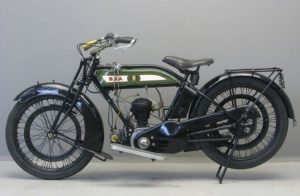
1926 BSA Model L SV 3½ HP 350cc motorcycle courtesy Creative Commons Yesterdays Antique Motorcycles, CC BY-SA 4.0
The introduction of the motorcycle to the BSA Police was perhaps inevitable, but it was never a replacement for the horse. In 1927, the first steps were taken to officially introduce motorcycles to the force. The first motorcycle used in the BSA Police was the British Birmingham Small Arms Company manufactured BSA L26 350cc model. This bike had first been marketed in 1923 as a 350cc side valve machine which was designated the Model L. It was a three-speed, with hand-change gearbox and chain final drive bike. It was one of the last flat-tank models. In its first year the bike was acclaimed a great success. ‘To the sporting solo rider who asks for a “go anywhere” mount, its records in the Scottish Six Days’ Trial and the International Trials in Sweden in 1923 stand as recommendation,’ declared Pitman’s Book of the BSA, reviewing the Model L. It is not generally known how many of these motorbikes were deployed to stations.
Produced by B.S.A. (Birmingham Small Arms Company) from 1927 to 1935 the “S” Series or Sloper with a 500 cc overhead valve engine was at first was fitted with a three speed hand change gear-box but from 1932 this was changed to a four speed box. It was capable of a cruising speed of 90 kph with a claimed top speed of 120 kph
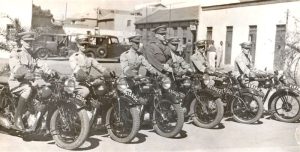
1930 Bulawayo motorcycle section on 495cc single cylinder B.S.A. “Sloper” machines
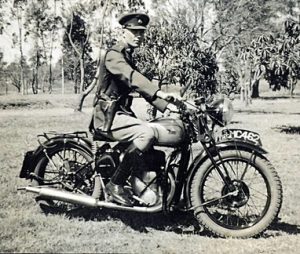
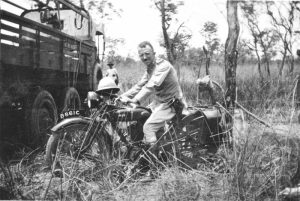
A 1937 B.S.A. M20, 500cc single cylinder machine at Mashaba
The M20 apart from serving the Force, became one of the most numerous motor cycles produced for the War Office in WW 2 with some 126 000 being built. Originally designed as a sidecar machine with a 500cc side valve four stroke, single cylinder engine with low compression giving a top speed of only 80 kph but with a lot of low end torque it proved itself a tough and reliable machine. The M20 started out in 1937 with a hand-change gearbox, with the lever on the right, (as photo) a rigid frame and girder forks. The hand-change suited sidecar usage but was dropped and replaced with a right-foot operated lever in 1939, in a one-up-three-down arrangement; the girder forks were replaced with telescopic units in 1947. Production ceased in 1955.
The 125cc James ‘ML’ or Military Lightweight motorcycle was a development of a pre-war design adapted for military use with the intention that it could be air dropped during and after the ‘D’ Day landings and so used by airborne troops and it acquired the nick-name of the “Clockwork Mouse”* It was fitted with foldable footrests and a quick release lock so that the handlebars could be turned down the machine’s centreline for easy storage and transportation.
*A paratrooper supposedly said “…release the handlebars, kick the starter and it runs like a clockwork mouse”.
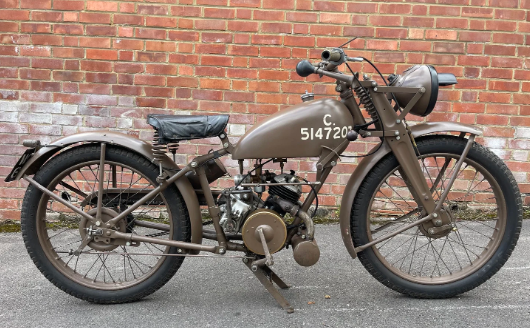
1945 Southern Rhodesia Women’s Auxiliary Police Service
despatch riders used the James ML125cc single cylinder machines
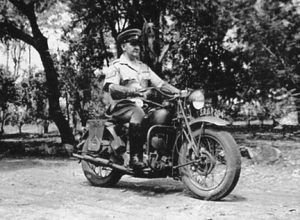
1948 an Indian ‘V’ twin 500cc model 741
The most common Indian motorcycle made for military use in World War II was the 741 a military version of the Thirty-Fifty. The Force had a few Indian 741s up to 1950 or so. It had a 500cc ‘V’ twin in-line air cooled engine, a three speed gear box, with a hand change gear lever and a foot clutch. Some 30 000 of these were used by British and Commonwealth forces during the course of the war and afterwards large numbers were sold off as “War Surplus”.
BSA’s first parallel twin, the 500cc A7, was built from 1946-1950. The design was almost completed in 1939 but WW2 intervened and interrupted civilian bike development. The range was launched in 1946 using a 495 cc (30.2 cu in) long stroke engine. An improved 497 cc (30.3 cu in) version based on the BSA A10 engine was introduced in 1950 giving a top speed of 140kph. The various A7 models continued in production with minor modifications until 1961/2 when they were superseded by the unit-construction A50 model. Over its life it came with three types of rear suspension, rigid frame, plunger and swinging arm. The last was introduced in 1954 after high wear on the plunger suspension led to complaints of poor handling
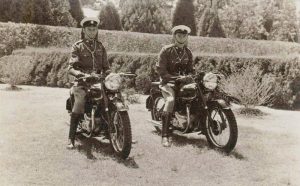
1949 B.S.A. A7 500cc twin cylinder machines on ceremonial escort duty
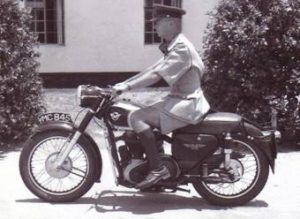
1955 Matchless 500cc G80 single cylinder with “jam pot” rear shock absorbers
A single cylinder 500cc machine built between 1946 and 1966, with four gears, foot operated gear change and hand clutch. It could be a difficult beast to start on a cold morning unless ignition, choke, throttle and exhaust valve lifter were just right and would backfire through the foot-starter with a kick like a mule. The initial “Candlestick” shocks held only 50 cc of SAE 20 weight oil but prone to leaks they were replaced by the “Jam pot” shocks in 1951. Acceleration was good with a top speed of 120 kph. Just coincidentally, many police recruits will have stabled the police horse, R/H 498 Matchless circa 1951-61 ridden by Smudge Smith.
A 500cc machine, the CS stood for Competition Scrambler. The models supplied to the Force were specially assembled, mainly by hand at the A.M.C. Competition Department at Plumstead, in London. They had modified suspension, larger front wheel, a lower compression ratio to allow for the 80 octane petrol in use, alloy cooling fins, lower gear ratios and different handling characteristics from road machines. Starting was easy if the ignition control and valve lifter were set and used correctly otherwise it had a very hard and painful kickback. The riding style was completely different to the road machine and if courses on riding this machine had been held it would not have gained such a poor reputation
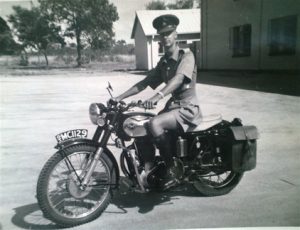
1958 500cc Matchless G80CS single cylinder – the “off-road” Matchless
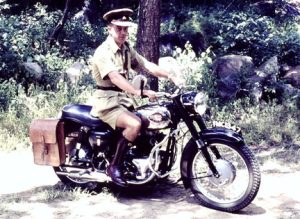
1959 650cc BSA Golden Flash twin cylinder machine
A 650cc parallel twin manufactured with different rear suspensions from 1949 to 1961. The early models had no rear suspension; then plunger type with shock absorber and springs; or from 1954, swinging arm; giving progressively improved comfort and handling characteristics. Comfortable to ride with smooth acceleration and capable of reaching 160 kph at sea level, it was an excellent machine for the Town Police environment
Motor scooters were originally sourced with a view for them to replace the motor cycle at town stations which fortunately did not happen. They were utilised mainly by Women Police officers on police duties in the towns The Vespas were later augmented by Lambretta 125 scooters. Both scooters were manufactured by Italian companies.
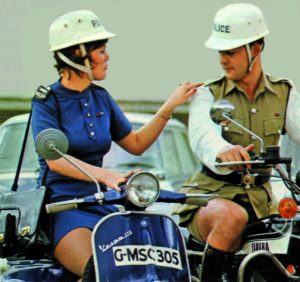
1974 WPO on a Vespa 125 motor scooter
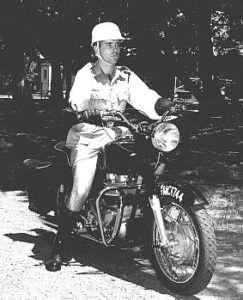
6344 Mike Werner; Salisbury Traffic
The Matchless G12 succeeded the G11 and was produced at the Matchless, Plumstead, factory from 1958 to 1966. This motorcycle was one of the last Matchless models to be marketed. It was a twin cylinder machine with drum brakes weighing some 200 kgs and had a top speed of just over 150 kph. They were mainly utilised mostly by the Traffic Branch, had good acceleration, were fast and handled well. Many of these bikes found their way to the Driving Schools and we in use in the early 1970s. This was the last of the British motorcycles to be acquired for use by the BSA Police, particularly due to United Nations sanctions against the Rhodesian UDI regime.
The Honda Dream 305cc was one of the first Japanese motor cycles to replace the force’s British BSA’s and Matchless motor-cycle fleet. Introduced shortly after UDI in 1967, the bike became the mainstay on many police stations around the country. A lightweight, very fast 305cc twin cylinder machine – one of several types that were given a trial by the Force during the search for a suitable all-round machine to replace the BSA’s and Matchless motor-cycles.
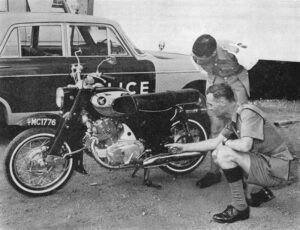
Two officers examine the Honda Dream 305cc
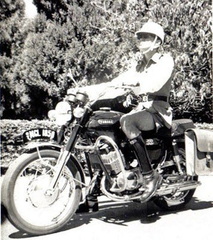
Ceremonial Escort mounted on Yamaha RD350 machines in 1978
This was the machine that was selected as the new breed of motorcycle to replace the ageing British machines in the Police Fleet following U.D.I. in November 1965. This was as much a result of U.D.I. as the fact that Matchless had gone out of business in 1966, followed by B.S.A. three years later, neither company being able to compete with the new Japanese models. It was a 350cc two stroke parallel twin machine, with a five speed gear box weighing 150 kgs and capable of exceeding 160kph at sea level. Unlike previous two-stroke machines it was fitted with an auto-lube system that automatically injected oil in the fuel being fed into the combustion chamber. The brakes were a single disc brake on the front wheel and a drum brake on the rear wheel described by Cycle Magazine as the best in its class.