
Land Rovers
Land Rover - 1949 to 1982
By Peter Huson
Mini Review: At the end of 2015 Land Rover ceased the Defender production after a continuous run of 67 years which started with the Series l Land Rover in 1948. Over this period some 2 000 000 Series 1, 2, 3 and Defender models had been built worldwide. This is a very brief look at the Land Rover, and touches upon those models up to Series 3 that we used in the Police. We had around 700 in the Police Fleet in 1978.
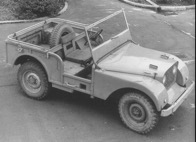
Land Rover Prototype – “Centre Steer”
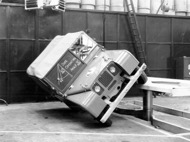
In 1947 the first Land Rover was designed by Maurice Wilks the Chief Designer for the Rover Car Company, inspired by a war surplus Jeep that he had on his property in Wales. The prototype was built on a Jeep chassis and axles and as the steering wheel was put in the middle, apparently to cater for both right and left hand drive countries, it was known as “Centre Steer”.
Development progressed quickly; the body panels were constructed from war surplus aluminium alloy while the gear box, axles and differentials came from the post-war Rover P3. These were mounted on a welded box section ladder chassis and powered by a 1, 6 litre 4 cylinder side-valve engine producing around 50 bhp (37 kW). It had permanent four wheel drive with a transfer gear box enabling low or high ratio gears to be selected. By 1948 it was an 80″ wheel base model, with doors as optional extras the windscreen was glass and the door window panels were Perspex.
First mention of the Land Rover in “The Outpost” came in November 1949 where under Bulawayo Station Notes the scribe “Saddlebags” noted “Cars to the left of them – trucks to the right of them. A whole crop of new vehicles has broken out in the district. Two or three of the Outstations and Bulawayo Urban have been issued with Land Rovers”. The following month in Station Notes “Dop” of Penhalonga wrote “ However in October a Land Rover was posted here and this has assisted considerably in keeping crime down. Remarkable how popular the Penhalonga details became when the new toy arrived.”
The earliest photograph of a Force Landrover that I have seen is the above one taken in August 1953, showing a Mzilikazi, Bulawayo vehicle, LL3903, (prefixed by SRG in triangular form) driven by 4840 Mike Purslow with his African Constable seated next to him. This is an early Series 1 SWB which also had a steel tubing and canvas canopy which gave some weather protection.
1955 saw the introduction of the first 5 door model. The 107 inch long wheelbase Station Wagon had seating for up to 10 people. The new Station Wagons were built with simple metal panels and bolt-together construction and were fitted with a ‘Safari Roof’ which consisted of a second roof skin fitted on top of the vehicle. This was to keep the interior cool in hot weather and reduce condensation in the cold. Vents fitted in the roof allowed added ventilation to the interior.
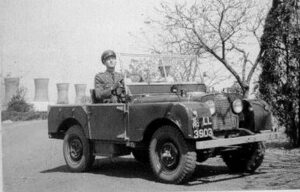
LL3903 – An early Series 1 model
In 1957 a more powerful 2 litre engine was introduced with the then standard Rover inlet over exhaust valve arrangement, i.e. the inlet valve was an overhead valve and the exhaust was a side valve. This with the cylinder head design made for an engine that could operate on low octane fuels without the risk of pre-ignition or “knocking”, thus giving trouble free running on the low octane petrol issued by CMED.
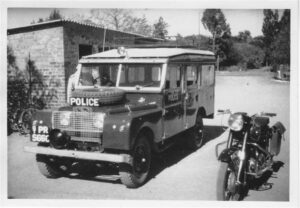
1958: Front view of 107 inch 5 door Series 1 Station Wagon
In 1958 the Series 2 with an increased engine capacity of two and a quarter litres and improved gear-box internals was introduced with wheelbase options of 88 and 109 inches. The bodywork was more rounded and small skirts were added to the lower coachwork to complete the effect. Station wagons were fitted with a fibreglass roof, and had 3 or 5 doors.
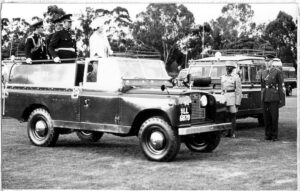
1960 – H.M. The Queen Mother reviewing the Force in a special bodied Series 2 Land Rover
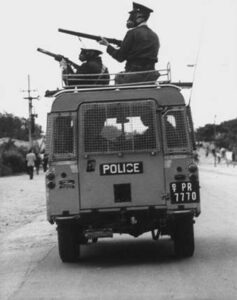
A Series 2 LWB Station Wagon built to Emergency Fleet Specifications
The Emergency Fleet model was an unique bodied Land Rover built on the Series 2 five door station wagon concept but with a metal roof. The luggage carrier was foreshortened and a hatch was installed in the roof above the centre seats to enable the occupants to stand up and utilise anti-riot weapons without de-bussing. This vehicle was photographed in the 1965 riots in Mpopoma Township, Bulawayo.
There were a surprisingly large number of these vehicles in the vehicle fleet, they had an improved performance over the long wheel base model but carried a smaller number of passengers. Although they were a smaller vehicle, the C.M.E.D. charged the same mileage tariff as for a Long Wheel Base Model.
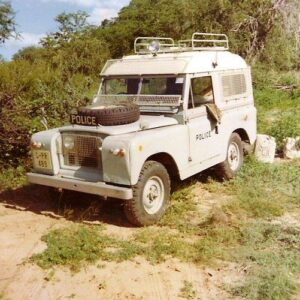
Series 2 – 88 inch Short Wheel Base Station Wagon with fibreglass roof
By 1968 headlamps had been moved from the grille area to the wings and in 1971 the Series 2 was replaced by the Series 3. It had a completely new gearbox with synchromesh on all four forward gears, modified gear ratios and a smoother operating clutch. A heavy duty rear axle was fitted to all 109 inch models and the electrical system was updated and the dynamo was replaced by an alternator. There were cosmetic changes to the interior and the radiator grille. There was a choice of either the 2.25 litre 4 cylinder engine or the 2.6 litre 6 cylinder engine and the Force had both in their fleet.
The POL Fleet
These Land Rovers appeared around the end of the 1960s and were a direct gift from South Africa to the British South Africa Police. Due to the fact that they were very second hand vehicles made to South African Defence Force specifications, (including individually opening windscreens, weapon clips, jerry can carriers, modified electrics and so forth), CMED declined to take them on to their books and they were owned and maintained by the Force. They formed part of Provincial Emergency Fleets, servicing and minor repairs were carried out by our Transport Supervisors and anything more serious was put out to the trade on requisition. As the war progressed some were fitted with mine protection and others were converted to Rhino MAP vehicles.